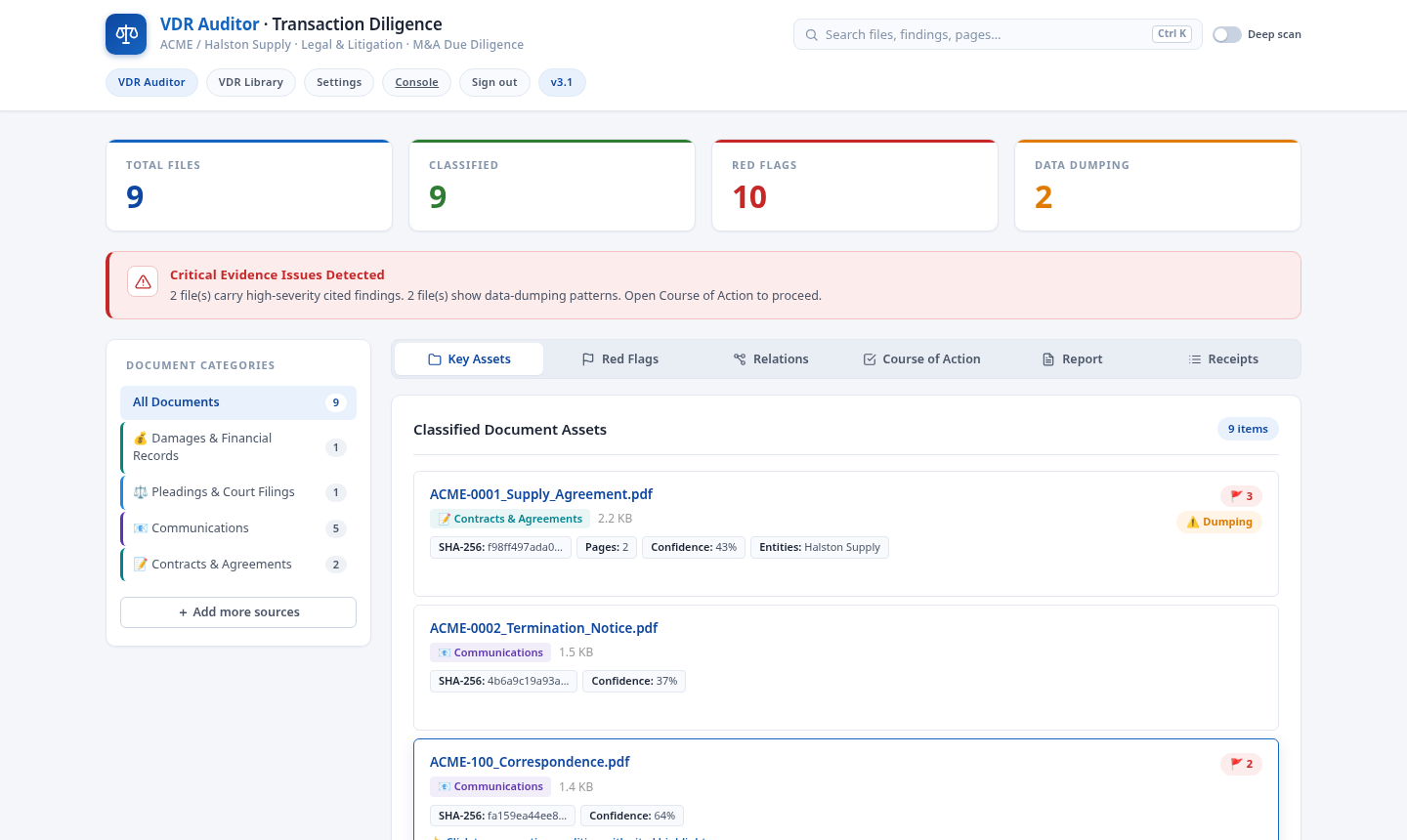
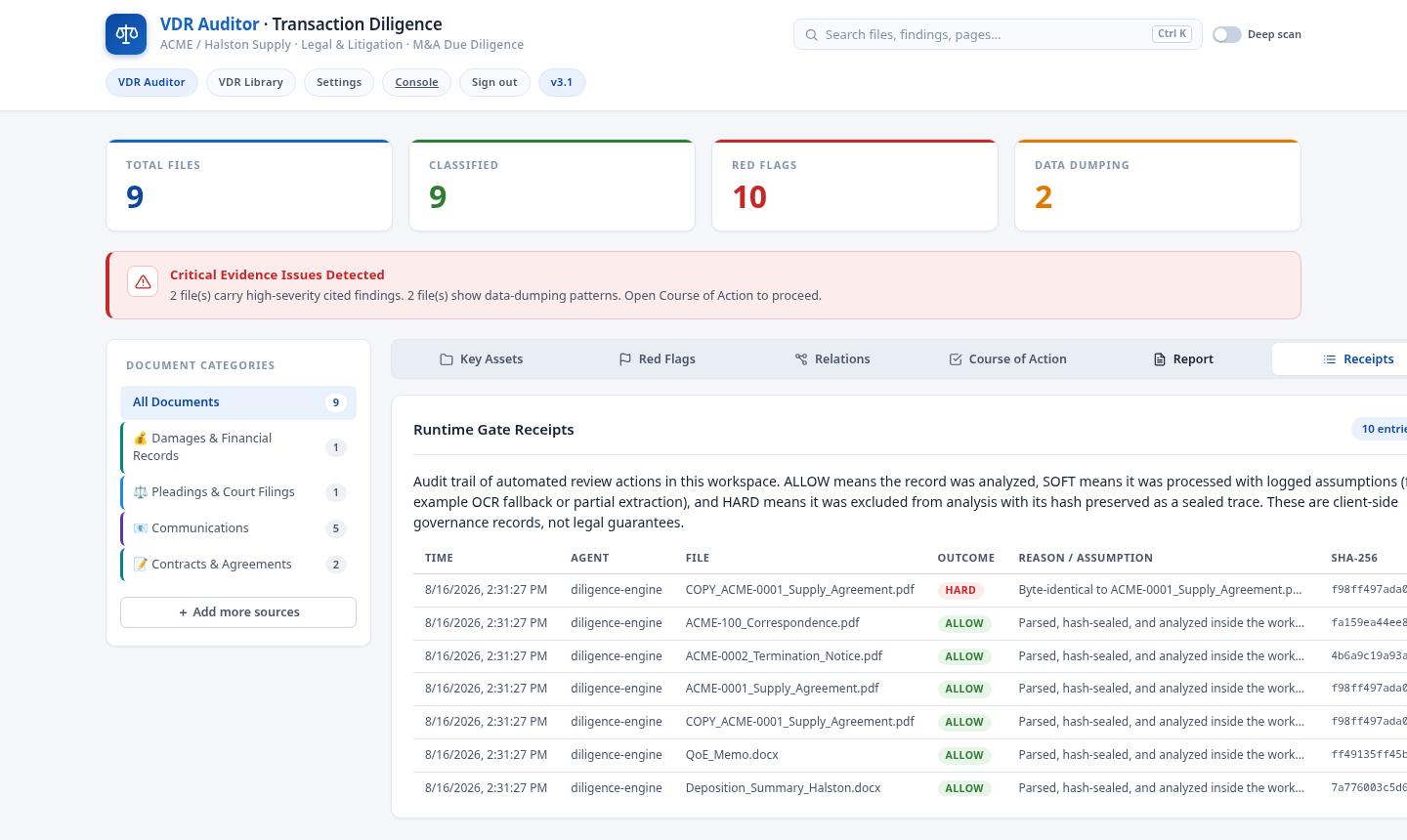
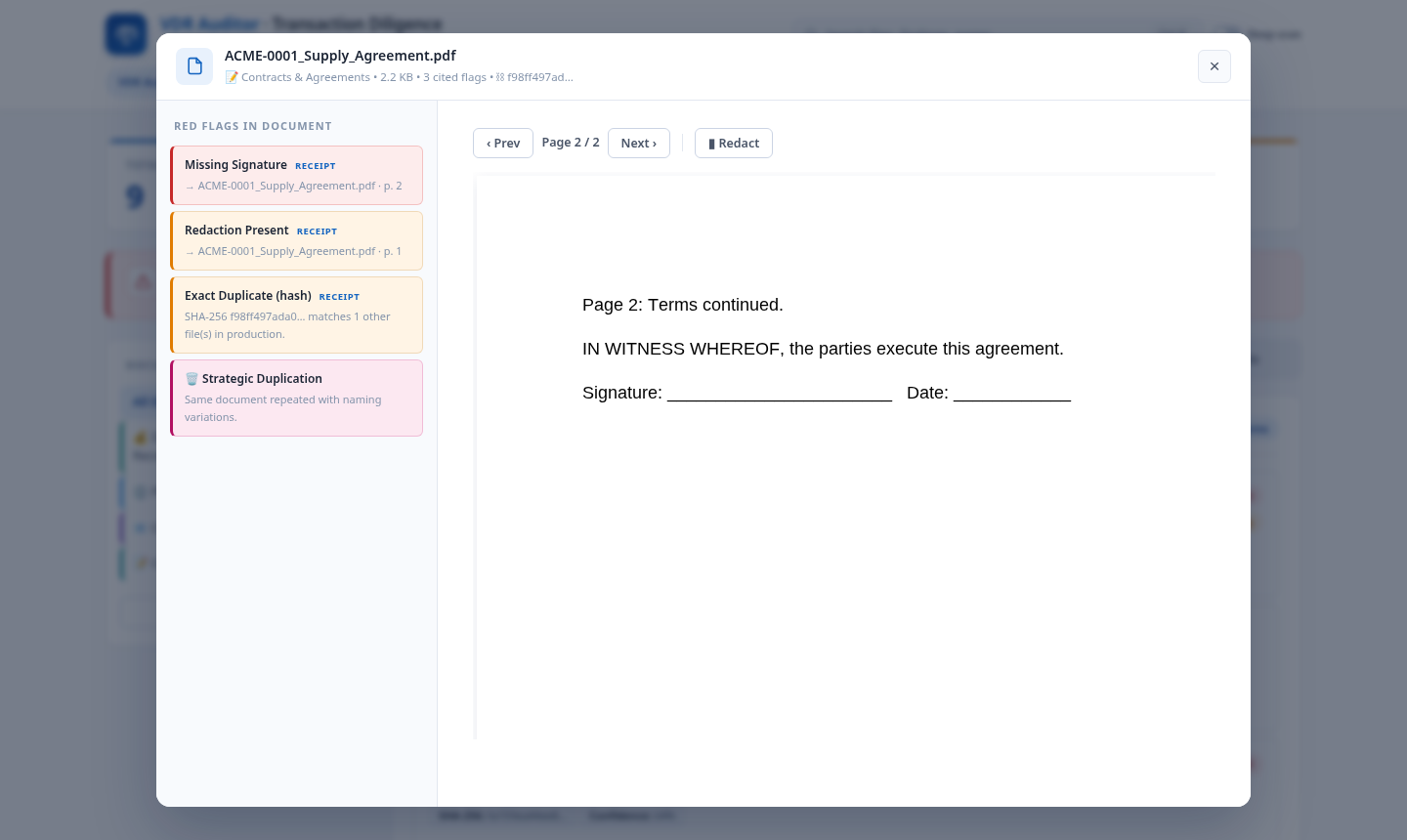
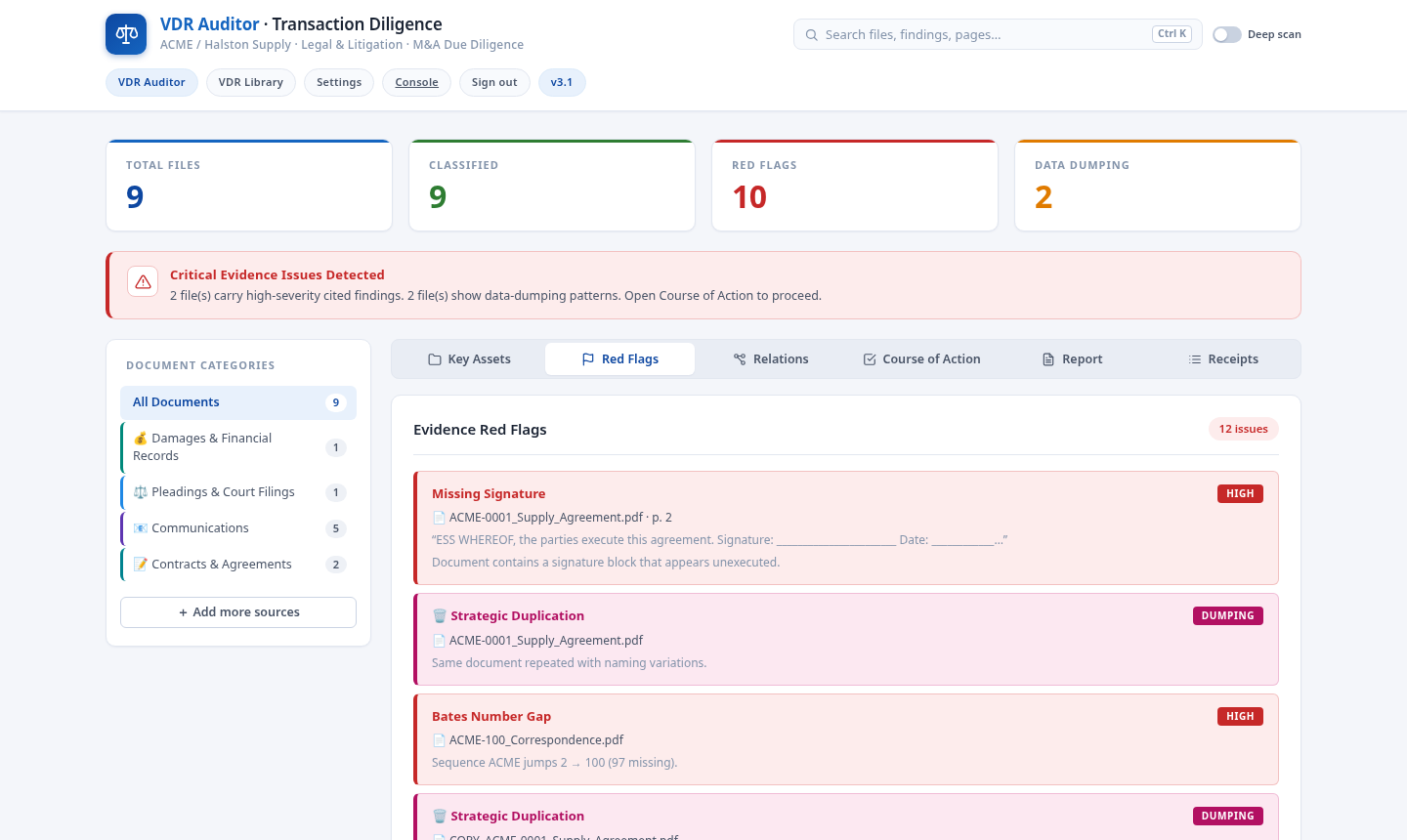
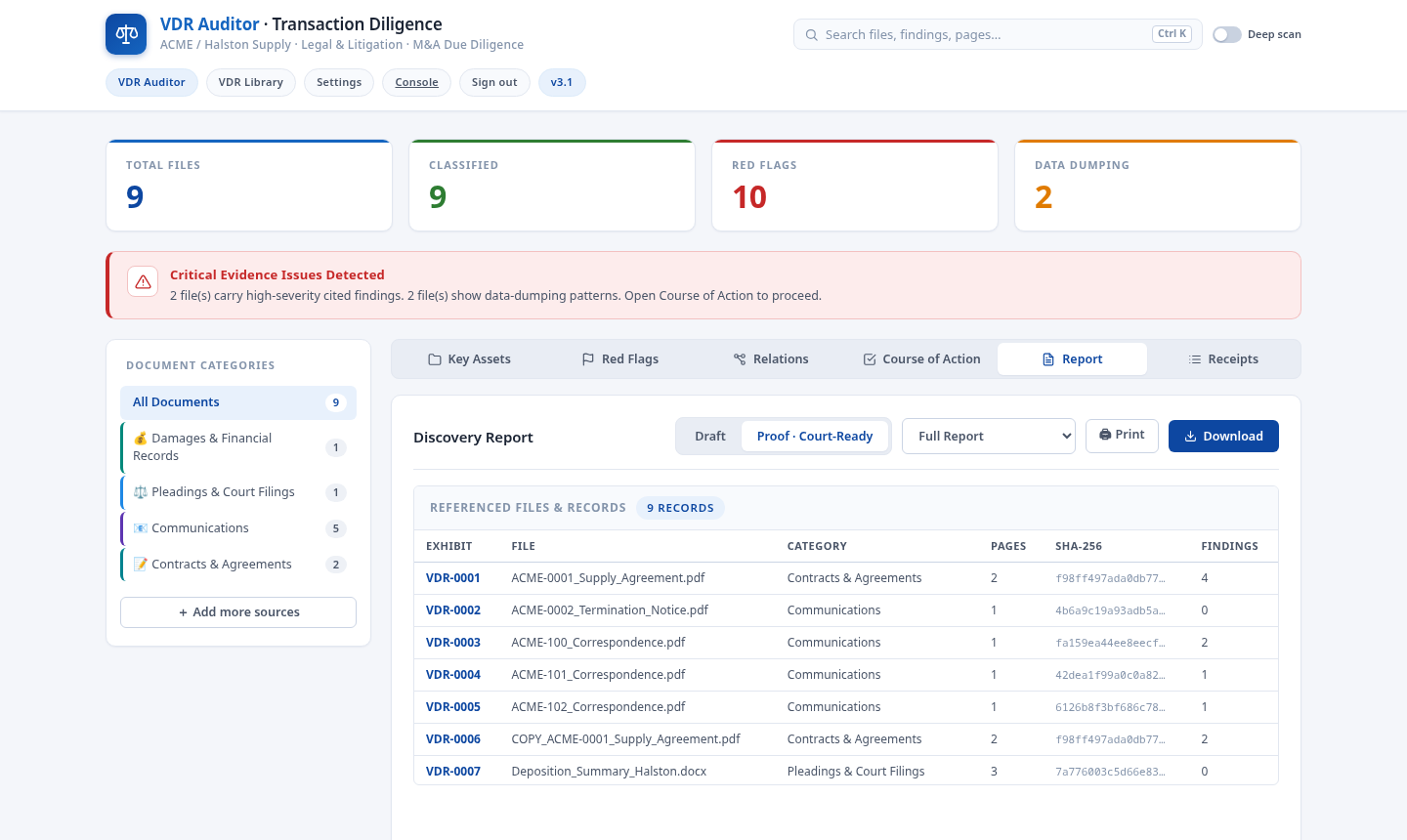
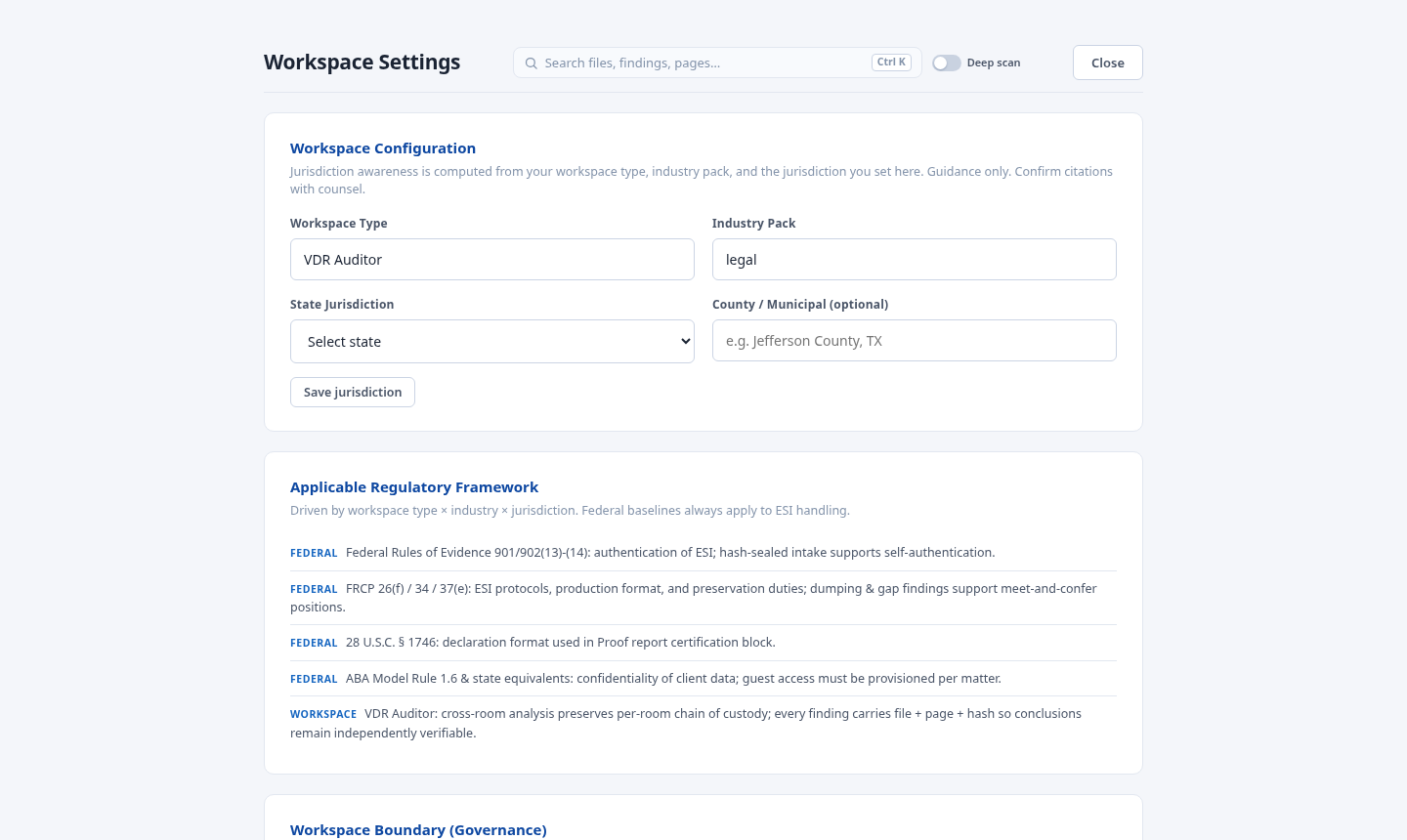
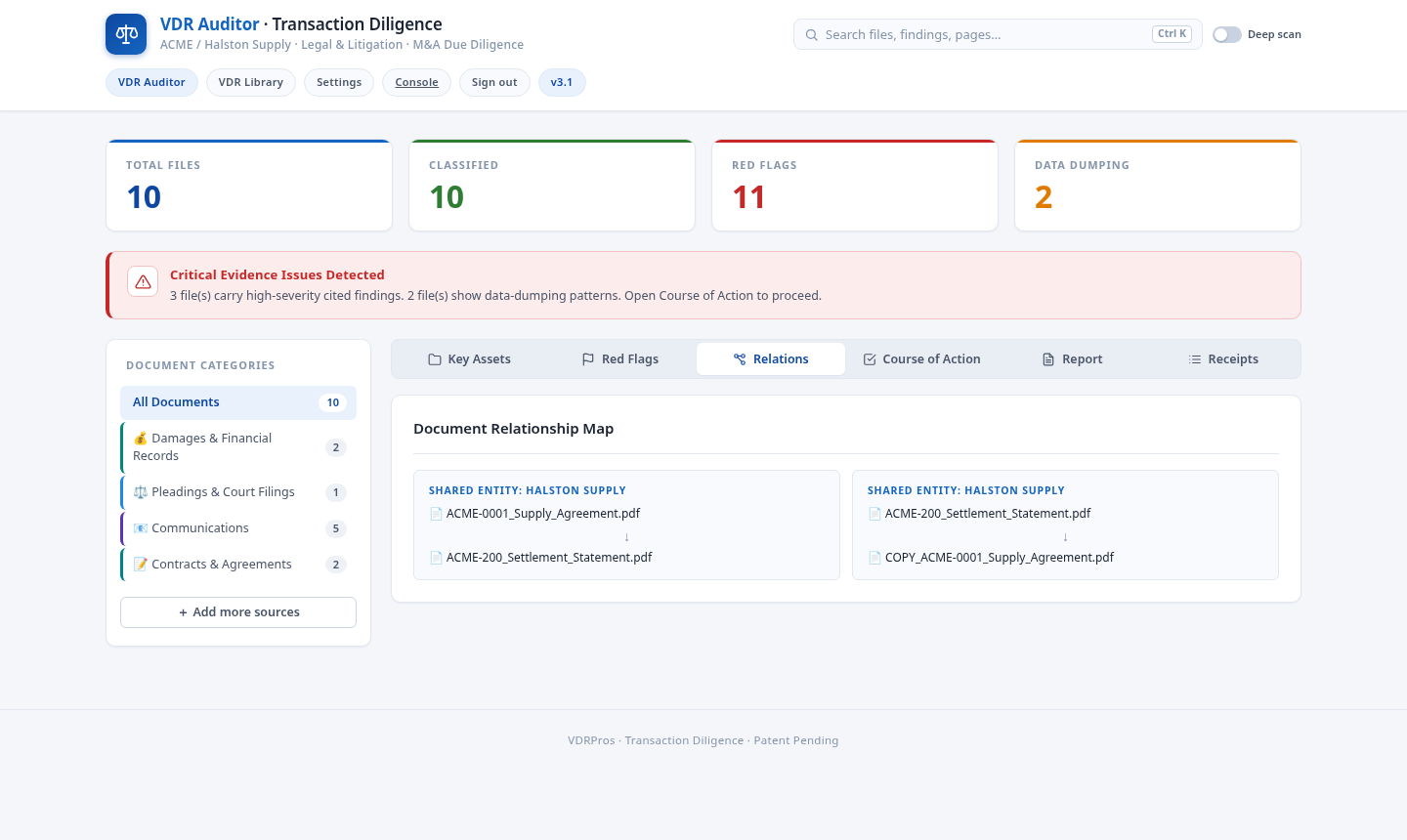
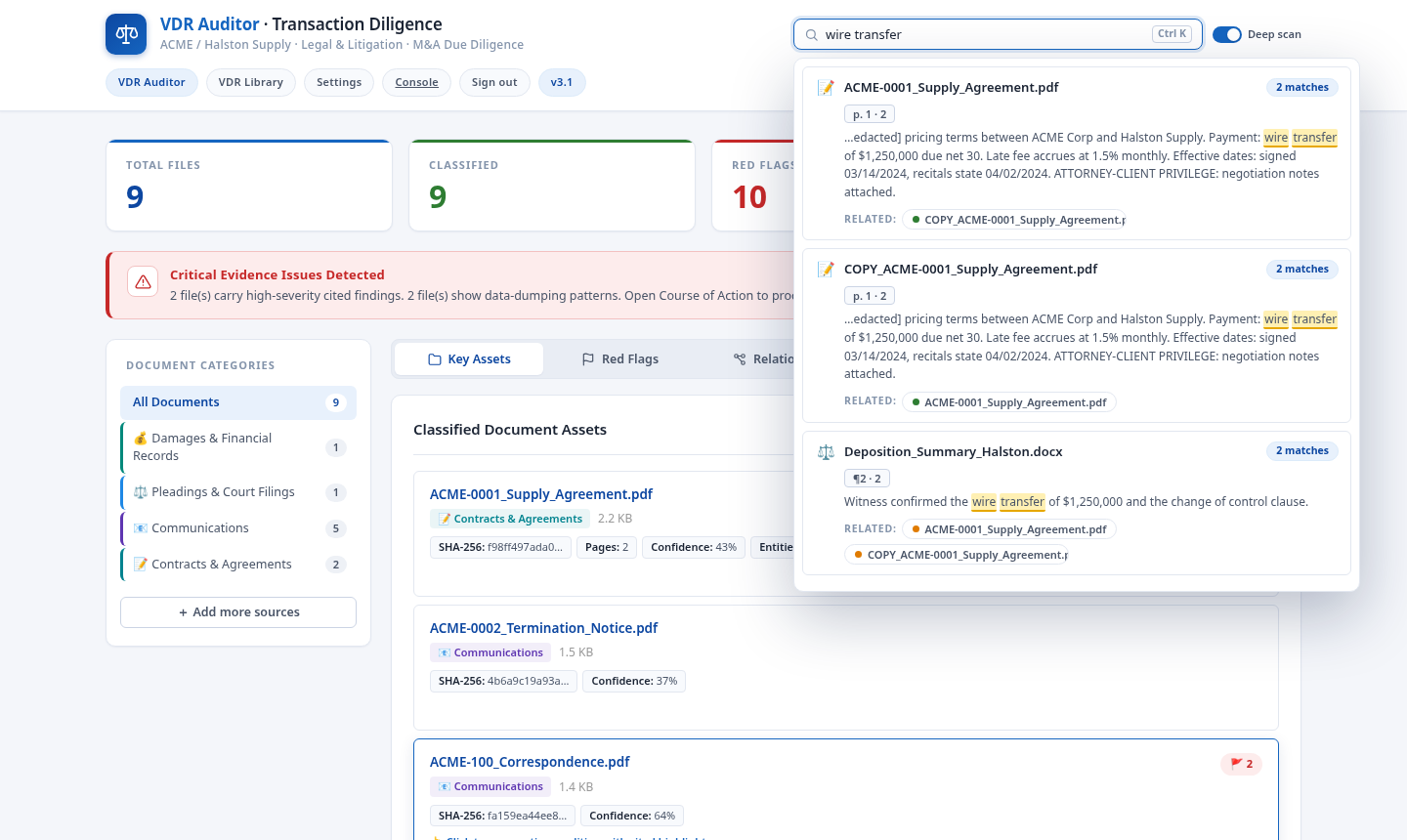
VDRPros is built for M&A, divestitures, fundraising, and high-stakes document review. It reads, OCRs, and seals your deal files locally in the browser during the first pass, then builds the index, flags the risks with exact citations, and drafts the diligence report. Nothing leaves your browser until you decide the files are clean.
Rooms, folders, ZIPs. Any format.
Extract, OCR, de-duplicate, structure.
SHA-256 seal on every file at intake.
Structural defects, gaps, and integrity checks.
Sorted by content, with confidence scores.
Red flags with exact passages and citations. Drafted.
Read and seal files in your browser during initial review.
Hash-sealed at intake. Re-verify any file, any time.
Autonomous, explainable, repeatable.
Compliance references matched to your workspace.
Chain of custody you can export.
The engine does the mechanical part of diligence: the reading, the sorting, the defect-hunting. It stops exactly where judgment begins.
Drop in data rooms, folders, or ZIPs. During the first pass, files are read, OCRed, and de-duplicated in your browser, with live progress as the set loads. Every file gets a SHA-256 seal at intake, printed in the report appendix and re-verifiable later.
Documents are sorted by content, not filename, each with a visible confidence score. Red flags quote the exact passage, file, and page, and every finding carries a signed receipt. Anything uncertain goes to quarantine for a person to triage, never into a guess.
You get a drafted diligence report organized by category: an integrity check, a short risk narrative, and prioritized actions with owners. The receipts log classifies every intake action with its reason and hash. When you are ready to share, the report, evidentiary index, and seal appendix export cleanly.


A finding you cannot verify is a finding you cannot use. Every flag quotes the passage that triggered it, with the file, page, and character offset.


The index sorts documents by content into the categories a deal team expects. Litigation and eDiscovery matters run on the same engine. Edit it to fit your deal.
The details below are how the workspace proves its work at scale.
One about where the first pass happens. One about how you prove integrity.

Both plans run the same engine. The difference is the job they are built for. Allowances follow the plan tier: Essentials, Flex, or Custom, sized by retained workspace storage and file count. Pricing is predictable and agreed up front, scoped to your transaction, never priced per page.
Start your 14-day free trial. No credit card required. Your workspace, findings, and settings are saved and waiting when you return. Nothing is shared between workspaces.
| Saved | Findings with their evidence snippets, index state, seals, role settings, and intake records. |
| Not saved | Files you only reviewed locally. Re-import the source folder to restore full text. |
| Portable | Export your workspace as JSON, or delete it outright, from the account page. |
Pick an industry pack at onboarding and the workspace inherits its categories, red-flag rules, regulatory references, and diligence vocabulary.
Productions, pleadings, and case files reviewed with cited findings and a receipted intake log.
Explore Legal & LitigationBuy-side and sell-side diligence with an index that builds itself and flags that cite their sources.
Explore M&A & Corporate DevelopmentJOAs, well logs, land files, and permits ingested at scale, with local OCR for scanned sets.
Explore Energy & Natural ResourcesFund documents, K-1s, 1099s, and exam files organized under a governance scope you can show.
Explore Financial ServicesClinical, regulatory, and corporate documents reviewed with care for sensitive, PHI-adjacent content.
Explore Healthcare & Life SciencesScanned leases, environmental reports, and zoning files OCRed into searchable, citable text.
Explore Real Estate & ConstructionProcurement files, FOIA response sets, and public records with a receipt for every intake action.
Explore Government & Public SectorCap tables, IP assignments, escrow agreements, and customer contracts organized and sealed.
Explore Technology & SaaSAn M&A data room that does the first pass for you. Cited red flags, an index that builds itself, and pricing that is never per page.
Explore M&A diligenceGet diligence-ready before the term sheet. Cap table, contracts, IP assignments, and financials organized into an investor-ready data room.
Explore fundraising prepScanned leases in. Cited findings out. Browser-native OCR for leases, asset books, environmental reports, and zoning files.
Explore CRE diligenceBoard materials with a seal you can verify. Hash-sealed minutes, approvals, and audit evidence with an exportable chain of custody.
Explore board governance
Most deal tools fall into two camps: legacy rooms built for a slower era, and lightweight trackers built for decks, not diligence. Here is how the categories compare.
| Capability | VDRPros | Legacy VDR platforms | Lightweight sharing tools |
|---|---|---|---|
| Pricing model | Predictable, agreed up front, never per page | Often quote-based, with per-page, storage, or overage components that can be hard to predict | Often per-user subscription tiers; costs can expand as reviewer counts grow |
| First pass on sensitive files | Local browser processing for initial OCR, review, and organization before any sharing step | Typically cloud-first: files are uploaded before meaningful review | Typically cloud-first: files are uploaded before meaningful review |
| Document integrity | SHA-256 seal per file at intake, printed in the report appendix, re-verifiable | Integrity controls and audit logging vary by vendor and tier | Link controls and analytics vary by plan |
| Diligence depth | Evidentiary index, cited red flags, and drafted reports | Often strong workflow tooling, with setup that can be implementation-heavy | Usually strongest at view tracking, not deep transaction diligence |
| Setup | Self-serve, browser-native | Often sales-assisted onboarding | Fast link sharing, but limited structure for full diligence |
Full-text search inside every file, extracted text and OCR text alike, with per-page cited results and related files sourced per result.
Vendor capabilities change and vary by tier. This table describes category patterns, not any single vendor.

No. During initial review, reading, hashing, OCR, classification, and the findings pass all run locally in your browser. You choose what leaves your browser afterward. The exact data flows are documented in our security disclosures.
Predictably. Engagements are scoped to your transaction and agreed up front, never priced per page. If scope grows late in the process, changes are re-agreed with you before they affect price, not metered into a surprise invoice.
Inside your workspace, role-based access covers five roles with granular permissions, so your deal team, counsel, and advisors each see exactly what they should. A hosted room for outside parties is on the roadmap; today, reports, indexes, and seal appendices export for controlled sharing with external stakeholders.
They go to quarantine, and the count shows on the report. A document filed on a weak guess is worse than one held for triage, so the threshold fails closed. The inspector shows the score behind every placement.
Auditor is the diligence engine: it reads across rooms and repositories and produces cited findings and reports. Vault is the secure repository: hash-sealed storage, permissioning, and chain of custody. Both run on the same engine.
No. It replaces the first pass: the reading, sorting, and defect-hunting that eats the most hours and produces the least judgment. Reports stay in Draft mode until you finalize them, and every finding quotes its source passage so you can check it instead of trusting it.
VDRPros drafts findings for professional review. Verify every action before you rely on it. Nothing on this page is legal advice.